
What Is a Triple Net Lease? A Complete Guide to NNN Leases for Tenants and Investors
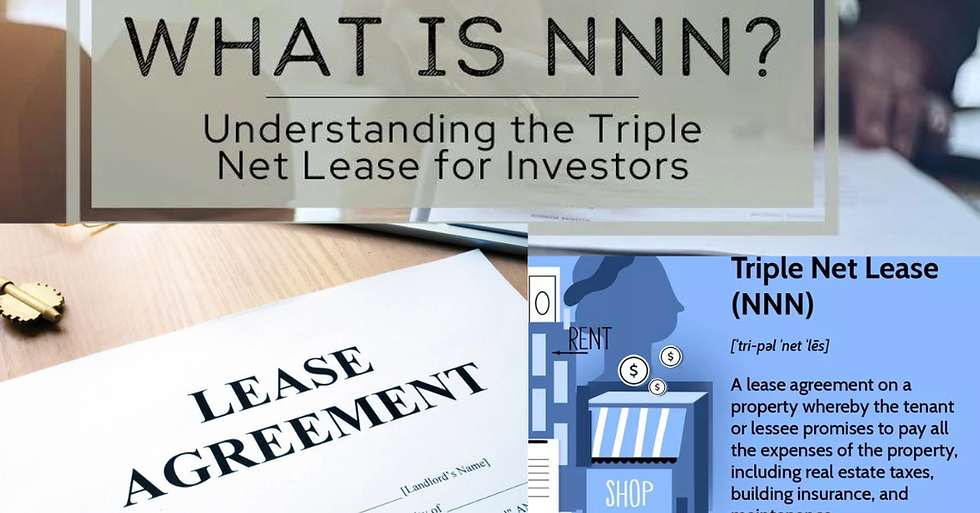
A triple net lease (NNN) is a commercial lease structure where the tenant pays base rent plus three additional expense categories: property taxes, building insurance, and maintenance/operating costs. Unlike a gross lease where the landlord absorbs these costs, a NNN tenant takes on a larger share of the property's operating expenses on top of their rent. Triple net leases are extremely common in retail and industrial commercial real estate and have specific implications — both risks and advantages — for both tenants and property investors.
If you've spent any time reading commercial real estate listings, talking to brokers, or reviewing lease proposals in Southern California, you've encountered the term "NNN" or "triple net." It appears in nearly every retail and industrial lease and in a significant portion of office and mixed-use transactions.
Yet many business owners and first-time commercial investors sign — or nearly sign — leases and acquisition contracts without fully understanding what those three letters actually mean for their monthly costs, their risk exposure, and their long-term financial obligations.
This guide explains exactly what a triple net lease is, how each of the three "nets" works, how NNN compares to other lease structures, what to negotiate in a NNN lease, and what it means from both the tenant and investor perspective.
The Three "Nets" — What Each One Means
The "triple" in triple net refers to three categories of expenses that the tenant pays in addition to base rent. Understanding each one clearly is the foundation for evaluating any NNN lease you're considering.
Net 1 — Property Taxes
In a triple net lease, the tenant pays their proportionate share of the property taxes assessed on the building. In California, property taxes are assessed at approximately 1–1.25% of the property's assessed value annually, with reassessments triggered by changes in ownership under Proposition 13.
For a multi-tenant building, each tenant pays a proportionate share based on the percentage of the total rentable square footage they occupy. A tenant occupying 2,000 SF in a 10,000 SF building pays 20% of the building's total property tax bill. In a single-tenant NNN property, the tenant pays 100% of the property tax.
Property tax is typically the most predictable of the three nets — it changes gradually in California because Proposition 13 caps annual increases at 2% until the property is reassessed (which happens at sale). However, if the property is sold during your lease term, the reassessment to the new purchase price can cause a significant jump in your tax obligation.
Net 2 — Building Insurance
The tenant pays their proportionate share of the landlord's property insurance premium — typically commercial property insurance covering the building structure, liability, and sometimes loss of income coverage.
Insurance costs are generally less variable than property taxes but can increase after claims, after coverage expansions, or in response to broader market-level insurance cost increases (which have been significant in California in recent years due to wildfire exposure and inflation in construction replacement costs). A well-negotiated NNN lease includes a cap on how much controllable expenses — including insurance — can increase in any given year.
Net 3 — Maintenance and Operating Costs (CAM)
The third net — and typically the most variable and most negotiated — covers the ongoing maintenance and operating costs of the property. In a multi-tenant building, this is usually called CAM (Common Area Maintenance) charges. In a single-tenant property, it covers all maintenance of the building itself.
CAM charges in a multi-tenant commercial property include:
Landscaping and exterior maintenance
Parking lot upkeep and resurfacing
Exterior lighting
Common area janitorial and cleaning
HVAC maintenance for shared systems
Property management fees
Roof repairs and maintenance (sometimes)
Capital improvements (sometimes — this is a significant negotiation point)
The variability of CAM charges — and the inclusion or exclusion of specific items within CAM — makes this the most important net to negotiate carefully. Our post on how to negotiate a commercial lease in Los Angeles covers CAM negotiation in detail, including CAM caps, base year settings, controllable vs. non-controllable expense separation, and audit rights.
How Triple Net Compares to Other Commercial Lease Structures
Understanding NNN in isolation only tells half the story. How it compares to the alternatives clarifies when each structure makes sense.
Gross Lease
In a gross lease, the tenant pays a single monthly amount that covers base rent and all operating expenses. The landlord absorbs property taxes, insurance, and maintenance within the rent figure. Gross leases are simpler for tenants to budget around — the monthly cost is fixed — but the base rent is typically higher than a NNN rent on an equivalent property because the landlord is pricing in their expense exposure.
When you see it: Gross leases are most common in smaller office buildings, some suburban office parks, and older retail buildings.
Modified Gross Lease
A modified gross lease — the most common structure for office space in Southern California — splits expenses between landlord and tenant in a negotiated way. The tenant typically pays base rent plus their share of increases in operating expenses above a base year level. The landlord covers the base year expenses directly.
Modified gross is a middle ground: more expense certainty for the tenant than a full NNN, but with some expense participation above the base year. The base year — and which expenses are included in it — is one of the most important negotiated points in a modified gross lease.
When you see it: Most commonly in office leases. Sometimes in retail leases in certain markets or building types.
Absolute Net Lease
An absolute NNN or "bondable" lease goes further than a standard triple net — the tenant is responsible for literally everything, including structural repairs, roof replacement, and all capital expenditures. This structure is most common in long-term single-tenant leases with large national credit tenants (fast food ground leases, pharmacy leases, etc.) where the landlord essentially becomes a passive income recipient for the full lease term.
When you see it: Long-term ground leases and sale-leaseback transactions with institutional tenants.

What a Triple Net Lease Costs in Practice — A Real Calculation
Understanding NNN theoretically is different from understanding what it actually adds to your monthly occupancy cost. Here's how the calculation works.
Sample NNN Lease Calculation
Assumptions:
3,000 SF retail space in a 15,000 SF shopping center (20% pro-rata share)
Base rent: $3.00/SF/month = $9,000/month
Annual property taxes on building: $120,000 → tenant's 20% share = $24,000/year = $2,000/month
Annual insurance premium: $15,000 → tenant's 20% share = $3,000/year = $250/month
Annual CAM expenses: $75,000 → tenant's 20% share = $15,000/year = $1,250/month
Total monthly occupancy cost: $9,000 + $2,000 + $250 + $1,250 = $12,500/month Effective rent per SF: $12,500 / 3,000 = $4.17/SF/month
The gap between the advertised base rent ($3.00/SF) and the actual occupancy cost ($4.17/SF) is 39%. This is why comparing commercial listings on base rent alone — without calculating effective rent including NNN charges — produces inaccurate cost comparisons between spaces.
Why Effective Rent Is the Number That Matters
Always ask for an estimate of the total NNN charges — sometimes called "CAM estimates" — from the landlord before you evaluate the economics of a leased space. Some landlords provide this proactively; others don't. A well-represented tenant always has this number before comparing competing spaces, because the base rent comparison is incomplete without it. Our post on maximizing commercial space efficiency and smart leasing decisions covers how to structure an apples-to-apples cost comparison across competing commercial spaces.
What to Negotiate in a Triple Net Lease
CAM Caps — The Most Important NNN Negotiation Point
A CAM cap limits how much your operating expense obligations can increase in any given year — typically expressed as a percentage cap (3–5%) on "controllable" expenses. Non-controllable expenses (property taxes, insurance, utilities) are usually excluded from the cap because the landlord genuinely can't control them.
Without a CAM cap, your occupancy cost can escalate significantly year over year as the landlord upgrades common areas, increases management fees, or simply experiences cost increases in maintenance and landscaping. Negotiating a CAM cap — especially on a multi-year lease — is one of the most financially impactful points a tenant can make in a NNN lease negotiation.
Exclusions from CAM
Not everything a landlord might try to include in CAM is appropriate or standard. Common exclusions that tenants should push for:
Capital improvements (major structural repairs, parking lot replacement) — these should be amortized over their useful life rather than expensed fully in one year's CAM
Landlord's management fees above a market rate (typically 3–5% of gross rents)
Costs attributable to other tenants' violations or negligence
Costs related to hazardous material remediation (unless caused by the tenant)
Legal fees for disputes with other tenants
The Base Year and Gross-Up Provisions
In modified gross leases — and sometimes in NNN leases with expense reconciliation structures — the base year determines the starting point from which future expense increases are measured. A base year set during a period of unusually low occupancy (and therefore artificially low operating costs) creates a wider gap between base year expenses and future actual expenses, increasing tenant pass-throughs faster.
A "gross-up" provision adjusts base year expenses to reflect full occupancy — protecting tenants from this structural disadvantage. These provisions are standard in well-negotiated commercial leases and should be requested as a baseline in any NNN transaction. Our post on the costly pitfalls in choosing the wrong commercial space and how to avoid them covers additional lease structure risks that commercial tenants frequently overlook.

Triple Net Leases From the Investor's Perspective
For commercial property investors, NNN leases have a specific appeal that has made them one of the most popular investment structures in the market.
Passive Income With Minimal Landlord Management
A well-structured NNN lease passes most operating expenses to the tenant — meaning the landlord receives a predictable base rent check each month without the landlord bearing significant management burden or expense variability. For investors seeking passive income from real estate without active management involvement, NNN properties — particularly single-tenant, long-term NNN assets — provide an attractive option.
Credit Tenant NNN Properties
Single-tenant NNN properties leased to national credit tenants (investment-grade retailers, fast food operators, pharmacy chains, dollar stores) are among the most liquid and widely traded commercial real estate assets in the country. Their value is driven primarily by the creditworthiness of the tenant and the remaining lease term — making them relatively straightforward to underwrite compared to multi-tenant properties with more complex occupancy dynamics.
Cap rates for credit tenant NNN properties in Southern California typically range from 4.5–6.5% depending on tenant credit quality, remaining lease term, rent escalation structure, and location. Our post on commercial investment properties in Southern California — a beginner's guide covers the full investment framework including cap rate analysis, due diligence, and 1031 exchange planning that applies to NNN investment acquisitions.
Risks to NNN Investors
NNN investments are not without risk. The most significant risks:
Tenant credit risk — if the tenant's business fails, the rent stops regardless of the lease structure. Credit quality analysis is essential.
Lease expiration risk — a long-term NNN tenant provides stability; a lease with 2 years remaining creates near-term re-leasing uncertainty.
Location quality risk — a NNN property in a deteriorating retail corridor may face significant re-leasing challenges if the current tenant vacates.
These risks reinforce why local market expertise matters as much as lease structure analysis in NNN investment decisions. Our investment properties service covers buyer representation for NNN and other commercial investment acquisitions across the South Bay and Greater Los Angeles market.
How DNG Commercial Helps Tenants and Investors Navigate Triple Net Leases
Deborah and Gulshen at DNG Commercial bring more than 20 years of combined industry experience representing tenants in NNN lease negotiations and buyers in NNN investment acquisitions across Torrance, El Segundo, Long Beach, Redondo Beach, Manhattan Beach, and the broader South Bay and Greater Los Angeles market.
For tenants, our commercial space real estate service includes full NNN lease evaluation: estimating actual occupancy cost including all three nets, reviewing CAM reconciliation procedures, negotiating CAM caps and exclusions, and ensuring the base year and gross-up provisions protect your interests over the full lease term. For investors, our commercial real estate agent service covers NNN acquisition due diligence, lease review, and tenant credit analysis.
For a broader understanding of how different lease structures affect commercial real estate decisions — from initial leasing through renewal and sale — our posts on the essential guide to commercial real estate and commercial real estate 101 — what every business owner should know provide the foundational context.
Frequently Asked Questions About Triple Net Leases
1. What does NNN mean in commercial real estate? NNN stands for triple net — a lease structure where the tenant pays base rent plus three additional expense categories: property taxes, building insurance, and maintenance/operating costs (CAM). These expenses are paid on top of base rent, making the total occupancy cost higher than the listed base rent figure.
2. Is a triple net lease good or bad for tenants? NNN leases are neither inherently good nor bad — they transfer operating expense risk from landlord to tenant, which can work for or against the tenant depending on market conditions and how the lease is negotiated. A well-negotiated NNN lease with CAM caps, appropriate exclusions, and a favorable base year can be a reasonable structure. An unnegotiated NNN lease with unlimited expense escalation can expose tenants to significant cost increases over time.
3. How much are NNN charges typically in Southern California? NNN charges in the South Bay and Greater Los Angeles market typically run $0.50–$2.00/SF/month on top of base rent, depending on property type, age, location, and management quality. Industrial properties tend toward the lower end; retail shopping centers toward the higher end. Always request a CAM estimate from the landlord before signing.
4. What is the difference between NNN and gross lease rents? In a gross lease, the landlord includes operating expense costs within the rent figure. Gross rent appears higher than NNN base rent for an equivalent property, but the total occupancy cost may be comparable or even lower than NNN depending on the actual operating expenses of the specific building. Always compare total effective occupancy cost — not just headline rent — across different lease structures.
5. Can NNN charges be negotiated? Yes — significantly. CAM caps, exclusions from CAM, base year settings, gross-up provisions, and audit rights are all standard negotiating points in a NNN lease. The landlord's initial proposal on these terms is rarely the final outcome with proper tenant representation.
6. What is a CAM reconciliation and when does it happen? CAM reconciliation is the annual process of comparing actual operating expenses incurred during the year against the estimated CAM charges the tenant paid monthly throughout the year. If actual expenses exceeded the estimates, the tenant pays the difference. If actual expenses were lower, the landlord credits the tenant. CAM reconciliation typically occurs within 90–120 days after the calendar year end. Tenants with audit rights should review the reconciliation statement carefully each year.
Need Help Evaluating a Triple Net Lease in Southern California?
Deborah and Gulshen at DNG Commercial represent commercial tenants and investors in NNN lease negotiations and investment acquisitions across the South Bay and Greater Los Angeles market — with the experience to evaluate total occupancy cost, negotiate CAM protections, and structure transactions that serve your long-term interests.
Visit dngcommercial.com or call 310.999.1203 | 562.225.9260 to schedule a consultation. You can also reach us at deborah@rpmres.com or gulshen@rpmres.com.


Comments